solution
Establishment of transportation management system
In response to the urgent need for advanced TMS in Shanghai Pharmaceutical Logistics Center, Fuller used its rich industry experience and TMS products to transform the overall process of Shanghai Pharmaceuticals' transportation management, connect all businesses into a whole, and establish a unified and complete transportation business management platform for Shanghai Pharmaceuticals.
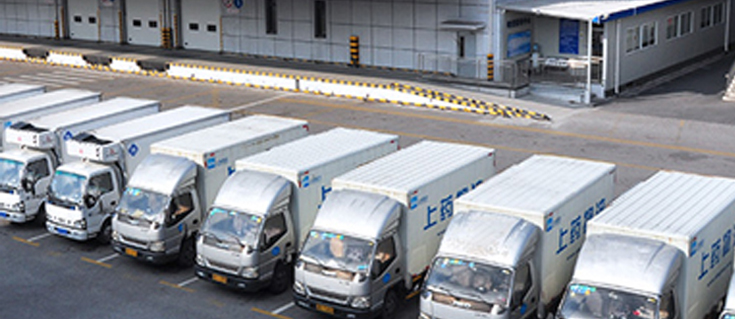
In-city self-delivery distribution process, including: Customer service order reporting, pre-scheduling, warehouse collection (providing collection guidance to the WMS system), formal scheduling, sub-warehousing and short-term barge scheduling, pickup and return information feedback, document printing, loading and shipping, GPS in-transit tracking, customer sign-in, which is also divided into regular shift scheduling and emergency delivery scheduling. ;
Out-of-city transportation and distribution process, including: Customer service order placement, automatic dispatch, dispatch information feedback, document printing, document handover, loading and shipping, in-transit tracking, customer signature, and receipt scanning, which are also divided into out-of-city self-service and out-of-city consignment. ;
Correspondingly, a self-shipment return process and an out-of-city consignment return process have also been established. ;
In addition, a series of management processes and models have been established such as receivables and payables, cost accounting, KPI assessment and vehicle management. All these processes and management models integrate the entire transportation management system, improving the overall management level and customer service level of Shanghai Pharmaceutical Logistics.
B/S system architecture
FLUX TMS adopts B/S system architecture, which provides good conditions for the system to be promoted throughout Shanghai Pharmaceuticals. All users of Shangyao Distribution, such as dispatchers, fleet managers, customer service staff, and document managers, can log in to TMS to perform required operations as long as they can open a WEB browser and connect to the Internet. Even relevant carriers can log in to FLUX TMS online to complete tracking tasks. At the same time, since maintenance only needs to be performed on the server side, the workload of system maintenance for IT personnel is greatly reduced. For Shanghai Pharmaceuticals Group, it is beneficial to software project control and avoid IT black holes.
FLUX DATAHUB
Through the FLUX DATAHUB interface platform, the TMS system can be seamlessly integrated with ERP, WMS and other systems. The order from the call center enters the TMS to drive the entire process, and then the WMS gives the wave information, and the TMS returns the order feedback information. During the process, the GPS information and carrier tracking information are accessed, all of which are automatically completed by FLUX DATAHUB. This avoids information islands and achieves effective sharing of information.
Intelligent scheduling rule engine
Fuller's intelligent scheduling rule engine has the characteristics of strong flexibility and high degree of automation. Schedulers configure the required scheduling rules according to their own needs. Each time you schedule a job, you only need to select the corresponding rule, and the main scheduling job can be automatically completed. Through the intelligent rule engine to assist out-of-city consignment and in-city dispatch, transportation pre-scheduling can be carried out in advance for routes and carriers, and transportation volume and capacity can be estimated to provide guidance for formal dispatch. When the WMS wave information is transmitted to the TMS, the pre-scheduling can be updated to formal scheduling according to the actual situation, optimizing loading, calculating the vehicle loading rate, improving the rationality of dispatching, and reducing human factors. After the introduction of the automatic dispatching function, the bottleneck of dispatch time is solved, the operation process is optimized, and the workload of dispatchers is reduced.
Shortage management
After the delivery pre-scheduling is completed, the city's self-delivery dispatchers can clearly see the distribution of goods delivered by each route in each warehouse in FLUX TMS, and choose to do short-term barge operations to a certain warehouse to generate short-term barge orders. After the short-term barge dispatch is completed, the pick-up warehouse after the short-term barge can also be clearly reflected in the schedule.
Tracking management
-
- City tracking management: Through access to GPS information, the current location of the vehicle can be found in the TMS system ; Time passing through major distribution points and entering and leaving the logistics center ; Temperature control, humidity, access control and other information of the vehicle associated with the document ; GPS abnormal information.
- Out-of-city tracking management: During long-distance transportation, TMS records the execution of waybills, understands abnormal situations that have occurred, and predicts possible delays through the carrier interface, carrier execution tracking tasks, tracking table import, personnel entry, etc.
- Customer service order tracking: Customer service can query the execution status of orders in FLUX TMS, including tracking various abnormalities or delays in order to communicate with customers in a timely manner and improve customer satisfaction.
billing engine
Mature and flexible transportation rate model supports a powerful billing engine. Through the setting of standard rates, the system realizes automated transportation fee settlement and transportation cost management, and monitors manual adjustment costs, thereby strengthening the ability to control overall logistics costs. ; Cost settlement supports receivable and payable settlement, monthly settlement and single-invoice settlement (settlement according to an order or a dispatch order). Transportation costs are transparent, and costs can be allocated to each order. At the same time, when selecting an external supplier, the system pre-calculates the theoretical freight rates of different suppliers for this transportation task based on the corresponding rate information of the line, and sorts the carriers with the best cost for the dispatcher to choose. The system also supports selecting the carrier with the best time.
KPI assessment system
Strengthen carrier management and establish an effective KPI assessment system. Through the collection of information such as loading time, shipping time, and sign-in time, a series of vehicle carrier assessment systems have been established such as delivery timeliness rate and sign-in intact rate. When choosing out-of-city transportation, KPIs are displayed in the system as important information for dispatchers to choose suppliers with better transportation services.

 FLUX SCE Digital Supply Chain Solution
 FLUX WMS Warehouse Management System
 FLUX TMS Transportation Management System
 FLUX Datahub Data Integration Platform
 FLUX SC²P Supply Chain Collaboration Platform
 FLUX LES Production Logistics Execution System
 FLUX WCS Warehouse Control System
 SaaS WMS Cloud Warehouse Management System