Solutions provided by FLUX for Nippon Express
Establishment of transportation management system
In response to Nippon Express China's urgent need for advanced TMS, Fuller used its rich industry experience and FLUX TMS products to transform the overall process of Nippon Express' transportation management, connect all businesses into a whole, and establish a unified and complete transportation business management platform for Nippon Express.
The overall process includes: Customer service receiving orders, importing into the system, dispatching designated carriers, warehouse tally, box information entry, document printing, shipping confirmation, in-transit tracking, customer signature, settlement form generation and calculation ;
During the process of setting the process, certain adjustments were made to the original organizational structure, and a dispatching department was added. The single dispatch by customer service was adjusted to professional dispatch by dispatchers based on system recommendations, which improved resource utilization.
Carrier selection, intelligent dispatching rules engine
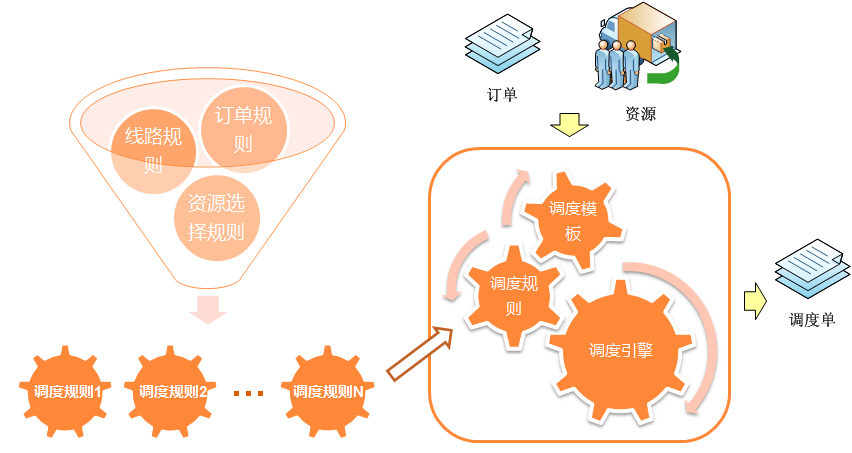
Fuller's intelligent scheduling rule engine has the characteristics of strong flexibility and high degree of automation. Schedulers configure the required scheduling rules according to their own needs. Each time you schedule a job, you only need to select the corresponding rule, and the main scheduling job can be automatically completed.
Through the intelligent rule engine to assist in the selection of carriers, the carrier can make freight estimates/timeliness estimates/score estimates based on the order's specific cargo volume, product type, delivery area, timeliness requirements, and weight range, select the appropriate carrier, and provide guidance for dispatchers. Improve the rationality of selecting carriers, reduce human factors, and reduce the workload of dispatchers.
open platform
Customer service can query the execution status of orders in FLUX TMS, including tracking various abnormalities or delays in order to communicate with customers in a timely manner and improve customer satisfaction.
Information interaction with carriers is divided into two types::
- Carriers with systems that can be connected can directly connect data. In this project, they connected with SF Express/Xinjie/Express 100 to issue tasks and obtain tracking information. In particular, they conducted in-depth docking with SF Express to determine whether the issued tasks fall within the delivery scope. The acquisition, printing, and cost information transmission of electronic bill numbers are all completed through the interface, which greatly reduces the actual communication workload.
- For some carriers that have not been able to achieve system docking, they can log in to the system to perform operations, including task determination, tracking information feedback, uploading sign-in pictures, and other functions.
In order to better improve customer satisfaction, FLUX TMS can provide customers with various operational information. Customers can log in to the FLUX TMS system to view business data, and can also open the order query interface so that receiving personnel can check the order status at any time.

 FLUX SCE Digital Supply Chain Solution
 FLUX WMS Warehouse Management System
 FLUX TMS Transportation Management System
 FLUX Datahub Data Integration Platform
 FLUX SC²P Supply Chain Collaboration Platform
 FLUX LES Production Logistics Execution System
 FLUX WCS Warehouse Control System
 SaaS WMS Cloud Warehouse Management System