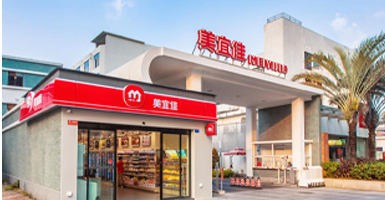
The main enterprise of Beiguorenbai Group, one of the top 500 Chinese enterprises, mainly engages in retail department stores, supermarket chains, electrical appliance chains, jewelry chains, outlets, catering and entertainment, warehousing and transportation, wholesale distribution, etc. It has more than 240 stores of various types, one large distribution center and one logistics industrial park, and more than 300 transportation vehicles.
Beiguo Mall has many sales channels, including traditional stores, e-commerce platforms and other social channels, and has a variety of business formats (retail department stores, supermarket chains, electrical appliance chains, jewelry chains, outlets, catering and entertainment, etc.). Therefore, there are many types of orders, involving many operating organizations and many operating links. FLUX OCP provides a unified order collaboration platform. Through FLUX DATAHUB, it seamlessly connects with upstream ERP, Beiguo ERP, e-commerce platforms, supplier order systems, etc. to achieve unified management of online and offline omni-channel and multi-format orders. Through multi-system collaborative operation, it simplifies the operation process and improves the efficiency of logistics center operations.
As a supply chain service platform, Beiguo Logistics provides professional and high-quality supply chain logistics services to cargo owners. Through the OCP order collaboration platform, the entire network's inventory can be shared. The cargo owner's goods can be stored in multiple warehouses. The OCP system automatically sources and allocates inventory based on order ownership. The entire network's inventory is managed and shared in a unified manner. All orders can select the optimal delivery location based on region and inventory volume, thereby improving the flexibility of order execution and inventory utilization.
Supplier direct operation means that the supplier's goods are directly transferred in the logistics center and shipped to the store, which saves the operation process of goods in the warehouse and improves the delivery efficiency. Beiguo's original process can only support full-container through operations, but as the proportion of new retail small businesses increases, there is an increasing demand for dismantling through operations. The FLUX system well supports the straight-through operation of disassembly orders. The OCP system automatically calculates terminal ordering requirements, transmits them to suppliers through API, and instructs suppliers to select and package respectively according to store ordering requirements, and print corresponding delivery labels. The warehouse WMS receives orders from OCP, automatically calculates and generates cross-docking instructions, and the through-dismantled goods are combined, boxed, and printed with box labels in the warehouse, and then sent directly to the collection location.
Suppliers reserve delivery time through the OCP platform. OCP transmits information to WMS. WMS automatically allocates platforms and transmits the information to the park management system. The electronic signage visually displays the corresponding platform number. ; The park gate system simultaneously receives relevant information and automatically releases reserved vehicles. ; After the unloading is confirmed, the relevant information is sent back to each system. For frequently arriving vehicles, WMS/TMS directly instructs the corresponding collection/delivery platform. Multi-system linkage simplifies the supplier admission process, improves the utilization rate of the park platform and reduces waiting time.
The management of vehicles (pallets, turnover boxes, turnover baskets, etc.) is a major feature of the supermarket format, and its application scenarios run through multiple operating scenarios such as warehouses, stores, supplier leasing, and driver transportation. The FLUX SCE solution designed and implemented full-process traceable management of vehicles for Beiguo, and implemented standardized vehicle management internally. In each link of vehicle circulation, WMS/TMS clients, RF, mobile APP, etc. were used to collect and record the quantity, location, status and other information of the vehicles, making the entire process traceable. ; Externally, we realize vehicle sharing and leasing management with upstream and downstream suppliers and store customers. The vehicle circulation information recorded and provided by the system provides a basis for subsequent cost management and supplier quota management.
More and more commodities, such as electrical appliances, milk powder, high-end wines, etc., require traceability management. The Fuller solution provides a unique code management solution for Northland's commodity safety traceability. By connecting with the upstream system, the unique code information of the commodity is obtained. In each link of the supply chain circulation, the unique code information is read, recorded, and verified, and the commodity circulation process is completely recorded, which can be queried in the forward direction and traceable in the reverse direction. According to the preset rules, the system can automatically send warning messages when an exception occurs to facilitate recall and other subsequent operations.
The visual order management provided by the FLUX SCE solution can provide suppliers and stores with an intuitive and immediate view of orders, thereby rationally arranging operations and improving operational sensitivity and accuracy. The system collects status information of all links in the order chain and relevant roles in the supply chain.: Suppliers, warehouses, transportation, operations, stores, consumers, etc. can all check the real-time status of orders through clients, WeChat official accounts, mini programs, APPs and other channels, and arrange follow-up operations reasonably. When an order is abnormal, the system will also automatically notify the relevant contact person of the cause and processing results so that strategies and responses can be adjusted in a timely manner.
By connecting Beidou, GPS and other equipment to achieve visual tracking in transit, you can grasp the running status and location of vehicles at any time, intuitively display the transportation process, and conduct comprehensive monitoring, dispatching, and preservation of goods, vehicles, and drivers. ; The system's automated dispatch function can issue transportation instructions to vehicles in transit at any time based on real-time vehicle information, improving vehicle utilization and transportation efficiency. ; Abnormalities can be observed and monitored to facilitate timely discovery and intervention.

Based on the analysis of orders by the OCP system, value-added services such as inventory optimization and automatic replenishment are provided for cargo owners. The OCP system can analyze the inventory structure of the cargo owner based on the frequency and quantity of the cargo owner's entry and exit, provide the cargo owner with replenishment suggestions and rational operation suggestions, etc., to help the cargo owner optimize inventory costs and improve supply chain efficiency. ; Procurement and suppliers can use the order analysis results of OCP to formulate reasonable production and procurement plans, improve inventory turnover rate, reduce product stagnation, optimize inventory costs, and increase capital turnover.
By analyzing the order structure, the WMS system formulates corresponding picking strategies and flexibly applies multiple strategies to improve operational efficiency. For the sorting and picking of BC commodities, the partition relay/parallel picking model is adopted, which is divided into multiple operating sections. The system guides the operators in each section to work in parallel using handheld terminals, greatly improving the operating efficiency. For e-commerce orders with small order product lines and large quantities, the merge picking secondary seeding operation mode is adopted. The WMS system automatically generates merge picking tasks according to preset algorithm rules. After the merge picking is completed, a mobile seeding wall is used for secondary seeding.
Beiguo TMS uses advanced automatic scheduling functions. The system automatically allocates orders and assigns vehicles, reducing manual participation and improving efficiency. TMS accesses the order, matches the route according to the delivery address, and automatically searches for the vehicle on the route under the route, giving priority to the vehicle that is not fully loaded on the route. If the match is successful, the driver APP will issue a pick-up (or delivery) instruction. ; If the matching fails, the order grabbing task will be issued to find the empty trains on the line, and the driver will grab the order through the APP. If no one grabs the order within the specified time, manual scheduling will be performed.